
Can justice truly be impartial when judges and jurors are human beings with beliefs, experiences, and emotions?
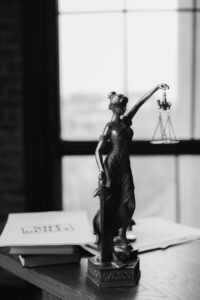
We often imagine justice as a blindfolded woman holding a scale. The blindfold represents impartiality—the idea that justice should not care about a person's wealth, race, social status, political beliefs, or personal history. The scale represents balance: one side should not outweigh the other simply because we sympathize with one person more than another.
But there is something almost ironic about this image. Justice may be blind, but the people responsible for carrying it out are not.Judges see. Jurors see. Lawyers see.
They all bring their own experiences, beliefs, fears, assumptions, and understanding of right and wrong into the courtroom. Even when they sincerely try to be objective, they are still human. So perhaps the more difficult question is not whether justice should be blind, but whether human beings are capable of making justice truly blind.
The philosopher John Rawls gives us an interesting way to think about this problem through his idea of the “veil of ignorance.” Rawls asks us to imagine designing a society without knowing who we would be within it. We would not know whether we would be rich or poor, powerful or powerless, healthy or sick, or even what race or gender we would be. Because we do not know where we will end up, we are forced to create rules that we believe would be fair to everyone.
The genius of this thought experiment is that it exposes how much our judgment can change when we know where we stand.
Imagine two defendants standing before a judge. One comes from a wealthy family, has a respected career, and speaks confidently. The other grew up in poverty, has struggled throughout life, and does not present themselves as well. The facts of their cases are identical. Should their backgrounds matter?
Legally, they should not. But psychologically, they might.
This is where the idea of justice becomes complicated. We like to believe that facts speak for themselves, but facts are interpreted by people. A judge decides how much weight to give certain circumstances. A juror decides whether a person's testimony feels believable. A lawyer chooses which facts to emphasize. None of these decisions happen in a vacuum.
The ancient philosopher Plato wrestled with a similar question in The Republic. He asked what justice actually is and whether a just society depends on individuals performing their proper roles. Plato's ideas suggest that justice is not simply about punishment or winning a case. It is about creating an order in which people receive what is properly due to them.
But what happens when the person deciding what is “due” is influenced by their own definition of right and wrong?
This is where I think justice has to be separated from personal morality.
A judge may personally dislike a defendant's actions and still be required to protect that person's legal rights. A juror may sympathize deeply with a victim and still have to determine whether the prosecution has actually proven its case. Justice sometimes requires us to reach a conclusion that we emotionally do not want to reach.
That is one of the hardest things about justice: fairness does not always feel fair.
We naturally want justice to produce the outcome we believe is morally right. But justice cannot simply become a reflection of whatever the majority feels at the moment. If it did, innocent people could be punished whenever public anger became strong enough.
This is why the philosopher Immanuel Kant argued that human beings must be treated as ends in themselves rather than merely as means to an outcome. A person accused of a crime does not stop being a human being simply because others believe they are guilty. Their dignity does not disappear because they are unpopular, frightening, or hated.
And perhaps this is what the blindfold is really asking of us. It is not asking us to stop seeing. It is asking us to see beyond ourselves.
A judge cannot erase their life experiences. A juror cannot erase every personal belief. No human being can completely remove themselves from their own perspective. But they can recognize that their perspective is limited.
True impartiality may therefore be less about having no biases and more about having the humility to question them.
This is also why courts have procedures, rules of evidence, appeals, opposing attorneys, juries, and standards such as “beyond a reasonable doubt.” These safeguards acknowledge something uncomfortable about human nature: we are capable of being wrong.
Justice needs these safeguards because good intentions are not enough.
A person can sincerely believe they are being fair and still make an unfair decision. A judge does not have to be corrupt to be mistaken. A juror does not have to be hateful to hold an unconscious bias. Human beings can distort reality without realizing that they are doing it.
So should justice be blind?
Yes—but perhaps not completely.
Justice should be blind to status, wealth, popularity, political power, and personal favoritism. But justice should not be blind to context. Understanding a person's circumstances can sometimes be necessary to understand what actually happened.
There is a difference between bias and understanding.
If two people commit the same offense under completely different circumstances, treating them identically may look impartial, but it may not produce the most just result. Justice sometimes requires us to recognize differences rather than pretend they do not exist.
That creates the central tension: Should justice treat everyone the same, or should justice treat people according to their circumstances?
Perhaps the answer lies somewhere between the two.
Justice should be blind enough that no one receives special treatment simply because of who they are. But it should remain perceptive enough to understand that human beings are complicated. The goal should not be to create a system pretending that humans have no biases.
The goal should be to create a system strong enough to withstand those biases.
The blindfold, then, may not symbolize perfect objectivity. Maybe it symbolizes discipline.
It reminds the person holding the scales that their personal feelings cannot become the law. It reminds them that the person standing before them is not merely a name, a charge, a political opinion, or a stereotype. They are a human being whose life may be permanently changed by a decision made in a courtroom.
And perhaps that is the closest humanity can come to truly impartial justice—not eliminating our humanity, but becoming conscious enough of it to prevent it from controlling us.
Justice cannot literally be blind because the people administering it must see.
But they must learn what not to let their eyes influence.
\ Get the latest news /
